Building and Maintaining Momentum with the MEC System
Long-term excellence is not emotional. It is systematic.
The Decades - Long Edge | Part 3 of 3
Parts 1 and 2 of this series, “The Decades-Long Edge” covered its not about growing older but getting better and why these thoughts quietly settle in on people as they get older:
“I’ve been doing this a long time.”
“I have enough experience.”
“At this stage, I can rely on what I already know.”
The series exposes The Disastrous Cost of Apathy, Burnout, and Complacency.
Part 3 is about the solution.
Not motivation. Not willpower. A system.
I call it MEC.
Mindset. Education. Consistency.
Three components. One formula. Decades of results.
M — Mindset: The Foundation of Every Transformation
Nothing changes until the way you think changes.
I have written about this directly on the Expect to Win blog in Are You Stuck? The Mindset Shift You Need. The core idea is this: a fixed mindset is the belief that intelligence, talent, and ability are static, that you’re either born with it or you’re not, and nothing can change that.  That belief is a ceiling. And most people never question it.
A growth mindset, by contrast, operates from a different premise entirely, that talent can be developed through disciplined work, intentional strategy, and mentorship. That belief is a runway.
The shift between the two is not automatic. It has to be chosen. Repeatedly.
Mental mastery - training your mind to direct its attention toward growth and possibility is a daily discipline. Not a weekend retreat. Not a quarterly offsite. Daily. It is what allows you to respond to adversity calmly, stay in motion when progress is invisible, and keep going when motivation fades.
Earl Nightingale said it plainly: “the mind moves in the direction of its dominant thoughts.” What you consistently feed it determines the trajectory you follow.
The move: Be intentional about your inputs.
What you read.
Who you listen to.
What you dwell on shapes what you believe is possible.
Guard that accordingly.
E — Education: The Repeatable Learning Loop
This is not about going back to school.
It is about treating learning as a permanent operating condition, not a phase you pass through on the way to knowing enough.
Consider two words that describe what this kind of education looks like in practice:
Perpetual: happening constantly, without interruption.
Never-ending: continuing indefinitely, without a finish line.
Education in this context is not an event. It is a metabolism. And like any metabolism, it has to be fed consistently to function.
The good news: the tools available today are extraordinary. YouTube alone contains more instruction, from credible voices in leadership, sales, marketing, health, finance, and virtually every discipline, than any university library. You have access to the best thinking in the world from your phone. That eliminates the excuse.
What it does not eliminate is the need for a plan. Free content without structure is just noise.
The move:
Block learning time on your calendar. Ten minutes of focused reading. Thirty minutes of study on a specific subject. Treat it like a revenue-producing activity.
Invest in yourself through books, coaches, and mentorship. As Dan Martell writes in The Martell Method, investing in yourself is like piling in firewood before expecting heat, the output cannot exceed the input.
Capture what you learn. Every failure, every “no,” every hard conversation is data. Weekly capture of those lessons becomes the raw material for your personal playbook over time.
C — Consistency: The Engine of Compound Results
Consistency is where most people fall short, not because they lack discipline, but because they underestimate how the math works.
James Clear puts it directly:
if you get one percent better each day for one year, you will end up thirty-seven times better by the time you are done.  The inverse is equally true. A 1% daily decline over one year compounds to a 97% loss of performance.  The gap between someone who improves slightly every day and someone who declines slightly every day is not a small gap. It is everything.
This is not motivational math. It is the actual mechanics of compound growth, and it explains why consistency matters more than intensity.
The science supports this. Research by Dr. Phillippa Lally and colleagues at University College London found that it takes an average of 66 days of consistent practice for a new behavior to reach automaticity the point where it becomes easier to do the habit than not to do it. The range in their study was substantial: some participants formed habits in as little as 18 days, while others took up to 254 days.  The variable was not talent. It was consistency.
Systems make consistency possible. Motivation is unreliable. It shows up when things are going well and disappears when you need it most. A system removes motivation from the equation. It creates the structure that makes daily action the default, not the exception.
I have written about this in detail in Consistency: Success’ Secret Weaponon the Expect to Win blog. As David Meltzer puts it: “Your consistency creates persistence because if your habit is to do something every day, there’s no way you’re going to quit.”  That is not soft encouragement. That is the mechanical reality of how habits override willpower over time.
The move:
Build systems, not streaks. A streak is fragile. A system is durable.
Show up on the days you don’t feel like it. Those are the days that separate the people who compound from the people who stall.
Track progress weekly. Not to judge yourself, but to recalibrate and stay in motion.
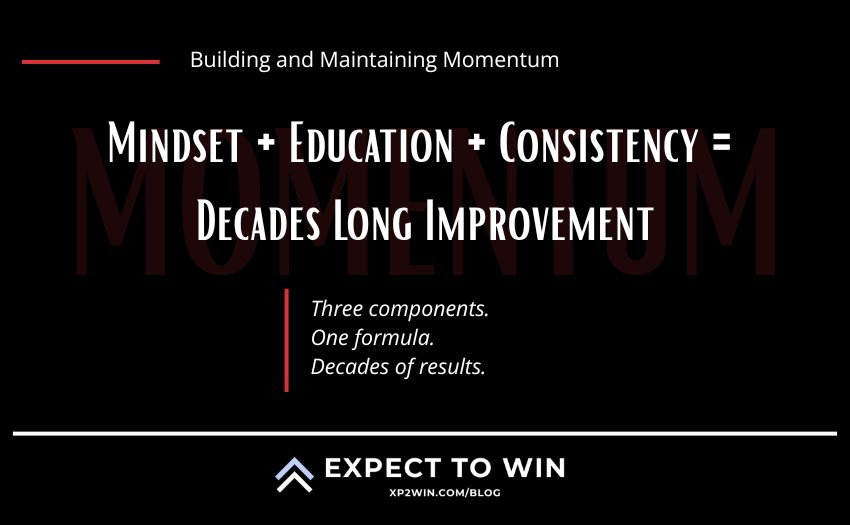
MEC System: Mindset + Education + Consistency
The Formula
Mindset + Education + Consistency = Decades-Long Improvement
This is not theory. It is the compound effect applied to human performance. Small, intentional actions, repeated consistently, guided by the right thinking, fueled by continuous learning, produce results that are not linear. They are exponential.
And the result of that equation is not just performance.
It is fulfillment. Confidence. Impact.
Impact Is the Outcome
When you commit to the MEC system, something happens beyond your own growth. You become a model for the people around you.
Through example — you show others the humility required to keep seeking improvement no matter how much success you have accumulated. That is rare. And people notice.
Through influence — consistent optimism and habitual learning are contagious. Leaders who keep growing pull others into growth with them.
Through performance — talk is cheap. Showing up and performing at a high level over decades is the only credibility that holds. Everything else is noise.
The Result: Decades-Long Improvement
No apathy.
No burnout.
No complacency.
No coasting.
Just intention, applied consistently, over time.
That is the edge. That is the system. That is how you make the rest of your life the best of your life.
This Is the Final Part of a Three-Part Series
If you missed Parts 1 and 2, they are in your inbox or subscribe below to get the full series and every edition that follows.
No noise. No spam. Just ideas worth your time, delivered straight to your inbox.