Rejection Isn't Personal. Your Response Is.
Meta description: Rejection in sales stings for a reason. Here's why "embrace the no" fails, what the research says, and a four-part system to master rejection.
I struggled with rejection for most of my career.
People told me not to take it personally. I never liked that advice. I'm an emotional person. When it feels like someone is rejecting me, I take it personally. Being told not to didn't change a thing.
What finally changed was understanding what I was actually being rejected for.
What a "No" Really Means
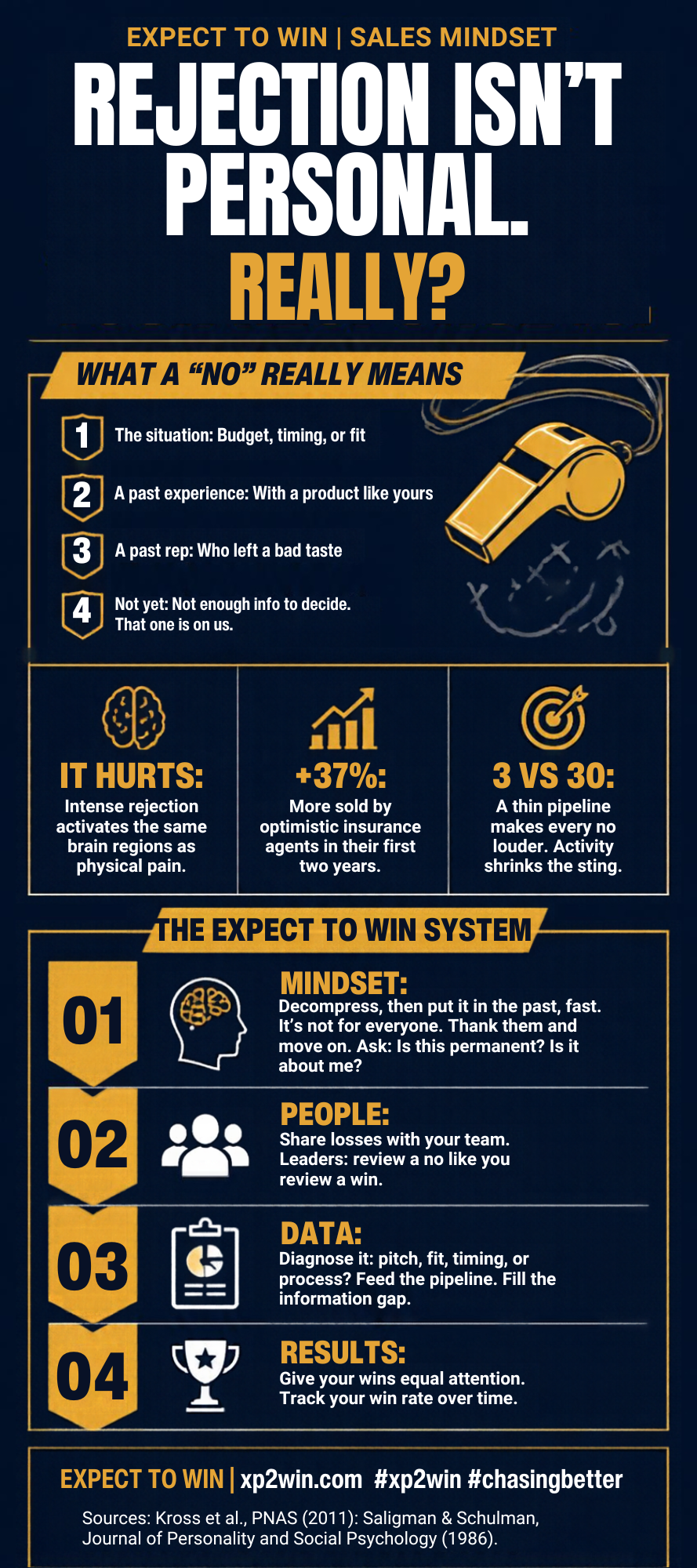
When a prospect says no, they aren't rejecting you. They don't know you well enough to reject you.
They're rejecting:
A situation: budget, timing, or fit
A past experience with a product or solution like yours
A past salesperson who left a bad taste
A decision they can't make yet: they don't have enough information to make a good, informed choice, so the safe answer is no.
That last one is on us. A lot of no's are really "not yet, I don't know enough."
Rejection shows up in a lot of forms. A short tone on the phone. A call that never gets returned. An email that sits unanswered. It's easy to read those as "they don't respect me" or "they don't value me."
Sometimes that's partly true. But it can also be fuel. If they don't see your value yet, raise it.
Why It Hurts So Much
There's a reason rejection stings the way it does. University of Michigan researchers found that intense social rejection activates the same brain regions that process physical pain (Kross et al., 2011).
Your brain isn't overreacting. It's built this way. That's why "just shake it off" fails. You can't shake off something your brain treats like an injury. You need a system.
Why "Embrace the No" Doesn't Work
You've heard it: it takes ten no's to get one yes, so go collect your no's. I don't buy it. Celebrating rejection isn't a strategy. It's a slogan.
Here's the problem. Pushing through is momentary. Rejection comes back, again and again. Reps without a real way to process it start avoiding it:
They make fewer calls
They give up on prospects too early
They stop asking for the order
In other words, they reject themselves before the prospect ever gets the chance.
People call that burnout. I don't buy that word either. [LINK: burnout piece] What actually happens is you stop getting better. Rejection drains the motivation to grow. Leave it unaddressed, and it becomes career-threatening.
Rejection Gets Louder When the Pipeline Is Thin
Here's the part nobody wants to hear. Rejection magnifies when you don't have enough activity. If you're not talking to enough people, every no carries too much weight. When there are only three prospects in the pipeline, losing one feels like losing a third of your month. When there are thirty, it's one conversation.
Sometimes the problem isn't the rejection. It's that you're flat not working hard enough. Activity doesn't remove the sting, but it shrinks it.
The Research Backs This Up
Psychologist Martin Seligman studied this with life insurance agents, a job built on hearing no. He measured how agents explained setbacks to themselves.
Agents in the more optimistic half sold 37% more insurance over their first two years than agents in the pessimistic half. The pessimists were also more likely to quit (Seligman & Schulman, 1986).
The difference wasn't talent. It was the story they told themselves about the no.
Optimists saw a setback as temporary, specific, and not about them.
Pessimists saw it as permanent, everywhere, and personal.
That's mindset. And mindset can be trained.
How to Master Rejection: The Expect to Win Approach
Mindset: Separate Self from Sale
Decompress first. After a tough loss, step away. Take a walk. Reset before the next call so you don't carry it in.
Put it in the past, fast. A good golfer forgets the last shot. A quarterback forgets the last play. A pitcher forgets the last pitch. They can't afford to carry it into the next one, and neither can you.
Accept that it's not for everyone. Seth Godin often makes the point that your work isn't for everyone. You can't please, satisfy, or take care of everybody. When it isn't a fit, say thank you and move to the next lead. Understanding that is what makes letting go possible.
Check your story. Ask two questions: Is this permanent? Is this about me? The answer to both is usually no.
Build belief. Deepen your knowledge of your product and your own expertise. Doubt fills whatever space belief leaves open.
People: Don't Process It Alone
Share losses with your team. Talking through a lost deal turns private shame into shared learning.
Leaders, set the culture. If losses get hidden, lessons get lost. Make reviewing a no as normal as reviewing a win.
Data: Treat Every No as Information
Diagnose the no. Was it the pitch, the product fit, the timing, or the buying process?
Track the pattern. One no is noise. Ten no's for the same reason is a message.
Feed the pipeline. Know your activity numbers. If the no's feel heavy, check whether you're having enough conversations.
Fill the information gap. If prospects keep saying no because they don't know enough, give them what they need to decide.
Results: Keep Score on the Wins Too
Give your wins equal attention. Most reps replay every loss and forget every win.
Track your win rate over time. Progress you can see is motivation you can use.
The Bottom Line
Rejection is coming. Every rep, every leader, every business owner will hear no. The ones who last aren't the ones who enjoy it. They're the ones with a system to process it, learn from it, and get back to work.
Rejection isn't personal. Your response is.
Expect to Win.
Your turn: What's your go-to reset after a tough no? Drop it in the comments.
Want more on mindset, leadership, and sales systems every week? Subscribe to Expect to Win.
#xp2win #chasingbetter
Sources
Kross, E., Berman, M. G., Mischel, W., Smith, E. E., & Wager, T. D. (2011). Social rejection shares somatosensory representations with physical pain. Proceedings of the National Academy of Sciences, 108(15), 6270-6275. https://pubmed.ncbi.nlm.nih.gov/21444827/
Seligman, M. E. P., & Schulman, P. (1986). Explanatory style as a predictor of productivity and quitting among life insurance sales agents. Journal of Personality and Social Psychology, 50(4), 832-838.