Talent gets the headlines. Culture wins the seasons.
Most leaders treat culture like a poster on the breakroom wall, something to talk about, not something to operate by. That’s a mistake. In a market where talent is mobile, attention is short, and trust is scarce, culture is the multiplier that separates the teams that grind through hard years from the ones that fold under them.
My working definition for culture:
Culture is the unspoken language that guides your team when no one is watching.
It’s the collective set of values, behaviors, and standards that decide how people show up — under pressure, in meetings, with customers, on the road. It’s the secret sauce no competitor can copy off your menu.
3 Major Reasons Culture Is a Real Competitive Edge and a Move You Make This Week
1. Culture Wins the Recruiting and Retention War
Talent today is a free agent. The Great Resignation was not a moment, it was a reset. People leave companies and teams over cultural misalignment far more often than they leave over compensation. Leaders who build a culture rooted in purpose and progress turn that trend into leverage.
Look at college football's transfer portal era, a churn engine designed to break rosters. Yet some programs hold their core together year after year.
Oklahoma football GM Jim Nagy on what kept the Sooners' best players in Norman after a rough 2024 season:
"The culture helps us retain more than anything." That culture, Coach Brent Venables' brotherhood model, was strong enough to keep key contributors like R Mason Thomas, Jayden Jackson, and David Stone home when the open market would have paid them to leave.
Lesson for business: If your top people are walking, the problem usually is not your offer. It is your environment.
2. Culture Turns Talent into Collective Excellence
Talent alone does not win championships. Aligned talent does.
Strong culture shifts the focus from stars to standards — the expectation that excellence is the team's pursuit, not any one person's. When that takes hold, high performance is expected, supported, and shared.
The Oklahoma City Thunder's 2024-25 championship run was the proof of concept. This was more than a basketball achievement. It was the culmination of strategic discipline, cultural conviction, and long-term vision — values embedded into the foundation of the organization by Executive President and General Manager Sam Presti since day one.
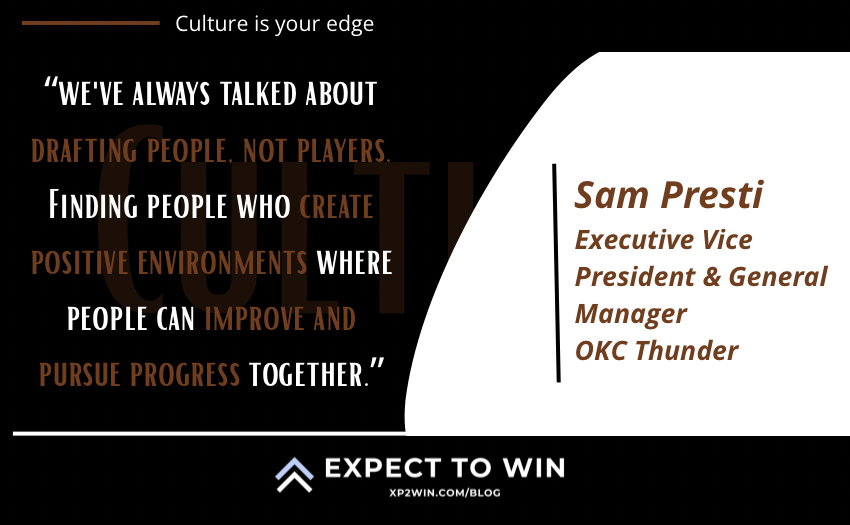
Presti put it plainly in The Daily Coach:
"We've said since we got here in 2008, we've always talked about drafting people, not players. Finding people who create positive environments where people can improve and pursue progress together. That's what we look for."
That philosophy paid off — not in one season, but across nearly two decades of intentional culture-building.
Lesson for business: Stop trying to hire your way out of a culture problem. Build a system where the standard is so clear that average performers play above themselves because the environment demands it.
3. Culture Enables Agility and High-Trust Execution
This is where most leaders underestimate what culture actually does operationally.
When trust is high inside an organization, decisions move faster. Teams absorb adversity without fracturing. People speak honestly instead of managing appearances. And when the environment is safe enough for candor, the best ideas surface — not just the ones that make the boss comfortable.
John Wooden put it directly in Wooden on Leadership:
"As a leader, you must be sincerely committed to what's right rather than who's right."
That single principle, consistently applied, changes the entire dynamic of how a team operates under pressure.
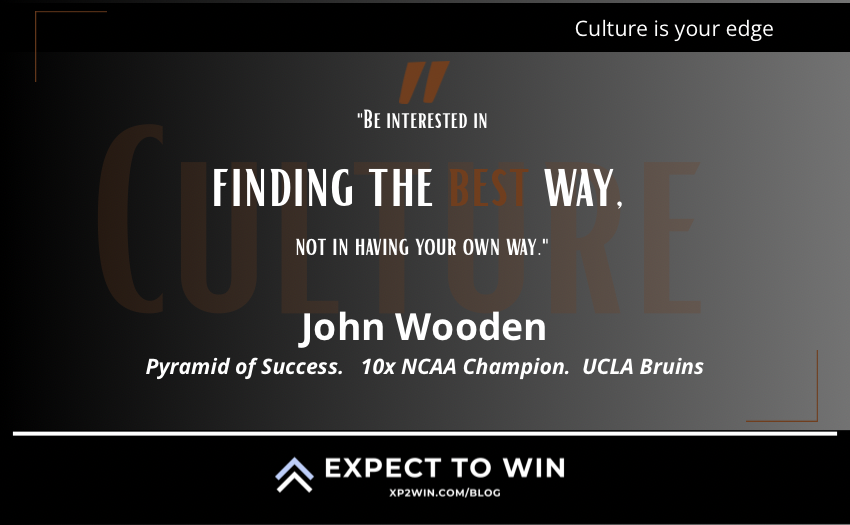
Culture is your edge - John Wooden - Finding the best way, not having your own way.
Wooden also identified cooperation as one of the foundational building blocks of any winning team, framing it this way:
"Be interested in finding the best way, not in having your own way."
That is not a soft leadership concept. It is an operational advantage. When collective best consistently outweighs individual ego, organizations unlock a level of execution that talent alone cannot manufacture.
High-trust cultures do not just perform better in good conditions. They hold together when conditions get hard. That resilience, the ability to stay aligned and keep moving when things break down, is what separates programs and organizations that sustain excellence from those that flame out after one good run.
Lesson for business: Vulnerability is not weakness in a leader it is infrastructure. The willingness to say "I don't know, what do you think?" builds the kind of trust that allows an organization to execute at full speed when it matters most.
Your Move
Three things to do this week, not next quarter:
Audit the unspoken language. Sit with three people who’ve been on your team 12+ months.
Ask: What do we say is important vs. what actually gets rewarded? The gap is your real culture.
Set three non-negotiables. Not twelve. Three.
The behaviors every person on your team lives, no exceptions, no excuses, no rank-based bypass.
Reward the controllables.
Effort.
Attitude.
Preparation.
Follow-through.
Recognize those publicly and consistently. Outcomes follow.
Bottom Line
Culture isn’t soft. Done right, it’s the most defensible edge you have.
Harder to copy than your product, harder to poach than your people, and the only thing that holds when the market turns.
Talent shows up. Culture sticks around.